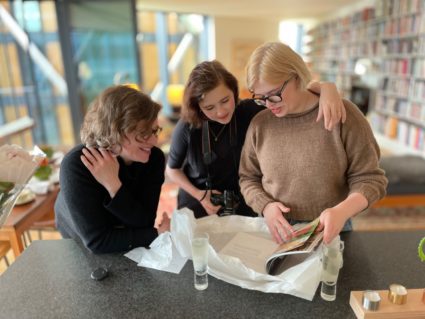
It’s the calm before the storm. I’m sitting here peacefully in my study watching my ever-patient husband tinker with one of the thousands of little fairy lights I bought to decorate the dining room (which is also the kitchen, and the library, of course), sending my parents flowers for tomorrow, making timetables about when things need to get done tomorrow, when 19 people will be seated around my table.
Of course, here in England the vast majority of the populace are not excited, they’re at school and work, planning nothing more sustaining to eat than a nice packet of fish and chips or a plate of shepherd’s pie, so it’s not the all-hands-on-deck Cookathon that it is in America. I really do miss that Thanksgiving feeling: of a gray day (always, it seemed!), the last leaves wafting down, everyone home and underfoot, an old movie or football game on in the background, and all sorts of unaccustomed people in the kitchen. In my childhood, this unlikely cast of characters included my poor mother, who was never happy in the kitchen, and my father, who appeared on special occasions like Christmas morning to make the pancakes and…
The calamari come into my tale in just a bit… I couldn’t resist the photo as it makes me hungry every time I see it!
This weekend saw quite the perfect launch of the weeks of festivity to come: the school Christmas Fair! This gargantuan festival happens only once every two years, as we would all die from the strain of its happening more frequently! The tombola in the Hall where unaccountably Avery won a bottle of wine — “is Pinot Grigio good?” she asks, a question that doesn’t come up for 14-year-olds at American school fairs! — the buskers playing “God Rest Ye, Merry Gentlemen” on uncertain but enthusiastic violins, the smell of greenery and poinsettias, mulled wine and mincemeat pies.
I was far too busy to take any photographs, but Avery snapped this one of a handmade wreath, along the “recycling” theme of all the decorations.
There came a frantic email the night before, “Can you all please eat something for supper that comes in a 400-gram tin, then bring them in? We need them for flower vases!” Haricot beans in homemade chicken stock it was, and two tins from our household to contribute.
Because I was deemed a volunteer with no particular skills but a great deal of good will, I was given the frantic task of managing the entrance desk, saying over the course of four hours “Three pounds for adults!” at least 700 times. The parents who tried to sneak by, “I’m just picking up my daughter!” as if it weren’t all for charity! But equally my lovely volunteer team (I selfishly chose all my favorite mothers to stand with me all afternoon, so there was some good banter and gossip in slow moments). The apple-cheeked tiny siblings of blase teenagers, the excitement of the “Vintage Cool” stall of second-hand clothes, where Avery snapped up a floor-length black velvet coat with a crimson lining, now quite her favorite possession.
John pitched in and we spent the whole day taking money, running out of this or that sort of change, racing into the school office to drop off £40 in notes to exchange for pound coins, frantically racing back to drop money into impatient hands, impatient to buy raffle tickets for impossibly posh prizes: weekends at houses in the South of France, iPads, a basket full of a dozen new cookbooks, and my own contribution: a pizza cookery lesson for two! I heard at the end of the day that a schoolgirl won it, so we’ll see if she takes me up on it: I thought it would be a lot of fun to make dough, and while it rises, teach them to make pesto, a homemade tomato sauce, basic chopping skills, how to prepare an artichoke, what mozzarella to choose… we’ll see!
The chilly November air swirled around our ankles, ruffling the white linen tablecloth I had brought from home to save the rental fee! Normally it lives on top of the fridge, awaiting the termly Lost Property luncheons, so it was happy to get an airing.
There were a couple of hilarious moments, as always happen when I’m with my friend Elisabeth. Once, a wife staggered past laden with raffle prizes, her coat over one arm, children tugging at her hands, and by her side, her husband stood, empty-handed but for her handbag which he stolidly held out to her, waiting till she shifted everything to have one finger free. Elisabeth and I burst into simultaneous giggles. “He couldn’t be seen, carrying his wife’s handbag, even for a minute!” At one point, I related to her the Saturday Night Live sketch called “The Change Bank”, where earnest tellers explain, “It’s simple. You give us a dollar bill, we’ll give you four quarters. Or, if you prefer, ten dimes, or even five dimes and ten nickels. And how do we make our money? VOLUME.”
Later, when the punters were being particularly difficult — six £20 notes in a row, for example! — Elisabeth hissed to me, “I’m sure that if we told them, ‘Give us three pound coins exactly, and you get in free,’ they’d go for it.”
Simply a glorious, hectic, crowded, loud, festive day, surrounded by smiling parents, frantic volunteers, healthy, happy children… a day when I felt a surge of gratitude for that wonderful school, where the normally serene headmistress played The Empress in the panto, and somehow ended up throwing a pair of underwear at my unsuspecting husband! Americans never fully understand panto!
Flogging decorations at the bitter end, folding up a very dirty tablecloth, turning in all the money, walking very slowly home with ears ringing and feet sore, back tired and hands filthy, feeling rather exhausted and keyed up at the same time. I stopped at my glorious fishmonger’s for advice on how to deep-fry scallops, and received the simple answer, “Don’t.” Too watery. Mikey and Tony agreed that the best thing to do with any scallop is to saute it, and certainly, there was nothing but glory piled up on our dinner.
Sauteed Scallops With Ginger, Lemon Grass and Sesame
(serves 2)
good splash toasted sesame oil
knob of butter
1/2 inch knob ginger, grated
2 cloves garlic, minced
2-inch stalk lemon grass, minced
juice of 1/2 lemon
Heat the oil and butter in a heavy frying pan till very hot. Stir in the ginger, garlic and lemon grass and sizzle just a tiny bit, then place scallops in the pan and cook for about 1 1/2 minutes on each side, till golden, but still completely tender inside.
Remove to a warm plate, then squeeze lime juice into the pan and sizzle up the buttery spicy juices. Pour over the scallops and eat straightaway.
This dish! So simple, so perfect. And along with that we had our gorgeous calamari, for which recipe there can be no finer advice than “Get perfect squid.” Perfect squid are nearly white under their reddish-gray skins, completely odorless, firm and shiny. You can either have your fishmonger clean them for you, or you can bring them home and have a little dissecting job of your own. My best advice is to watch your fishmonger do it first, or watch a video on YouTube, try it for yourself afterward, and if you’re grossed out by it, have the professionals take care of it. But at least once, it’s very interesting to pull out the cartilege, to squeeze the ink sacs, to get that squid completely pristine.
Then cut it into rings and cut the fins into slivers, and clean the tentacles perfectly. Now you’re ready to cook.
Calamari
(one large squid will feed four people as a starter)
1 squid
1/ cup homemade breadcrumbs
1/2 cup panko breadcrumbs
1/2 cup cornflour/cornstarch
1 tbsp Fox Point seasoning
enough rapeseed oil to come up 1 inch in your cooking pan
1 egg
2 tbsps single cream
Pat the squid dry with a paper towel. Then on one large plate, combine the crumbs and cornflour and Fox Point thoroughly. On another large plate, combine the egg and cream.
Assembly-line fashion, line up the egg plate and crumb plate next to each other with an empty large plate at the end. Heat the oil till a breadcrumb dropped in sizzles instantly. Now, dip your squid into the egg mixture and mix with your fingers till all pieces are wet. Next, dip the squid in handfuls into the crumbs and toss them until completely coated. Place on empty plate.
Depending on the size of your frying pan, fry the squid very briefly in batches, lifting them out with a slotted or wire spoon onto a heavy pile of paper towels. The squid will cook in a VERY short time, perhaps 45 seconds depending on the heat of the oil. As soon as they are browned, take them out. Eat IMMEDIATELY with a tartare sauce, a chill-tomato-horseradish sauce, or a light, clean sauce of fish sauce, rice wine vinegar, lime juice and sugar. Or all three! It’s the holidays.
There is nothing like homemade calamari! Serve them on a kitchen island, with everyone standing around watching you lift them frantically out of the oil, grabbing at the hot, crunchy squid, anxious to get the crispiest morsels.
It was a lovely end to a lovely day. Avery was safely in the hands of a friend, watching the new “Harry Potter” movie, so we were free to cook things she doesn’t like. There are small compensations to her occasional absences.
I feel utterly unready for Thanksgiving, and yet, that is sort of the point. It’s meant to be a cook-all-day, run out for forgotten ingredients, never take the apron off experience, after all. We shall be 17 around the table, actually two tables as John and I struggled downstairs with the little table in Avery’s room at the top of the house. The two turkeys are thawing in their salty, herby water, I having long ago decided that in matters of holiday poultry, I want a cheap, frozen, big-breasted bird, not a purple heirloom beauty with feathers still stuck in at strategic points. So frozen it is.
I’m tempted to make an addition to the usual Thanksgiving treats and add my new Favorite Soup of All Time. Have I been boring you with our tales of butternut squash? In our new very-low-carb lifestyle, it’s been a very good substitute for potatoes: steamed, mashed and baked, there are no complaints. John will eat ANY amount of the stuff roasted with sage. So today, on yet another gray November morning just about to see sunset even though I’d only been awake a couple of hours, I decided that soup was the way to go. And boy, did I get that one right.
Roasted Butternut Squash Soup with Calvados and Sage
(serves at least 4)
1 large butternut squash, cut in half lengthwise
butter to smear on each half
6 sage leaves
sea salt and pepper
1 shallot, roughly chopped
4 cloves garlic, roughly chopped
chicken stock to cover all vegetables, at least 6 cups
good splash Calvados
single cream to drizzle
Lay the butternut squash halves, buttered and with sage leaves on them, in a roasting tin and roast at 200C/400F for 45 minutes. Drip the melted butter from them into a frying pan and fry the shallots and garlic till soft. Scrape the cooked squash and sage leaves into a large stockpot and add the shallots and garlic and melted butter. Pour in chicken stock to cover, then the Calvados. Simmer for 10 minutes then whizz with a hand blender till perfectly smooth. Drizzle cream and serve hot.
This soup! Gorgeous. Rich, multi-layered, homey, comforting, warm and delicious. Just like the holidays, in fact. Let the games begin!
One of the most satisfying things in the world, to me, is to eat something truly inspiring out there in the world, think on it for a day or two ( or between lunch and dinner), and then recreate it in the cozy warmth of my kitchen, these November days. The fact is, if the sun is going to set at 4 p.m., I think the only recourse we have is to pretend that it’s dinnertime, and cook something elaborate to keep us going.
It always helps in these moods to have a friend to inspire me, and on Friday, it was my pal Charlie. We met two years ago on a five-day intensive (as in no phone, no newspapers, no cars, no escape) food writing course in deepest, darkest Devon. We became instant friends, engaging in what Charlie calls “banter,” in which we seem to do nothing but laugh at each other’s wit. Don’t you find that witty people make you wittier? I have to try that much harder, when I’m with Charlie, to think on my feet and find things to laugh about. It’s an addiction.
We always meet up and do foodie things together, so we can experience that most delicious of triumvirate pleasures: laughing, and eating, while talking about food. So Friday was “Masterchef Live” at the annual food fair in Olympia, the giant exhibition space near us. We met up in the spitting rain, folded our umbrellas and plunged into the melee. First up: the live Masterchef cook-off between Celebrity Masterchef winner Lisa Faulkner, she of the famed deep-fryer “Spooks” episode — I’m sure there were plenty of deep-frying jokes when she first began the competition! — and last year’s winner, Dhruv Baker, a truly inspirational Indian-English fusion cook. Crispy-skinned sea bream versus puff pastry fish pie… such fun to see them cook LIVE! A couple of terrible jokes led Charlie to quip, “Bring in the Luftwaffe, there’s been a bomb!”
And later in the morning we saw Dhruv cooking chicken ballotine, which sent me straight home to replicate it, as you see above. After Avery’s and my afternoon yesterday shopping for the first of the year’s Christmas ornaments, it was very pleasant to come home and mess up a clean, tidy kitchen with a complicated-ish recipe. The word “ballotine” is French for “bundle” and that’s your goal, to make a lovely chickeny bundle.
Chicken Ballotine With Marsala and Goat Cheese Sauce
(serves 4)
4 chicken breasts, tenderloin removed and set aside
12 mushrooms, chopped
3 stems fresh thyme, leaves only
1/2 shallot, minced
2 tbsps olive oil
1 tbsp butter
sauce:
1 tbsp butter
2 cloves garlic, minced
1/2 shallot, minced
1/4 cup Marsala wine
1 cup chicken or beef stock
3 oz goat cheese
2 tbsps double cream
Lay each chicken breast on a cutting board and pound with a mallet until flattened. Put the chicken tenderloins in a food processor and whizz until grainy. Remove and set aside in a bowl with the fresh thyme leaves, then give the same food processor treatment to the mushrooms and shallots. Mix all together with the chicken.
Lay each chicken breast flat, and place 1/4 of the mushroom mixture on the breast. Roll up and then roll up in a long piece of plastic wrap, like a sausage, or log. Do this for all four breasts. Twist each end of each log and tie in a knot. Place in boiling water for 15 minutes.
While the chicken poaches, melt the butter for the sauce in a small frying pan and fry the garlic and shallots till a bit browned. Pour in the Marsala and cook until reduced to about 3 tbsps, just a little bit of liquid with the garlic and shallots sort of shivering in the simmering bit of liquid. Add the stock and boil till reduced just slightly, then whisk in the goat cheese and cream. Simmer low while the chicken finishes cooking.
When the poaching 15 minutes are over, heat the olive oil and butter for the chicken in a large frying pan. Cut open the plastic-wrapped chicken over the sink and drain well. Place the unwrapped ballotines in the frying pan and fry on each side, on medium heat, until brown all over, perhaps 3 minutes total cooking. Don’t overcook or the chicken will become dry.
When ready to serve, slice the ballotines into four slices per “bundle”, then drizzle the sauce over.
GORGEOUS.
This dish is warm, savory, complex in flavor, rewarding and quite professional-looking! If you’re not cutting down on carbs, by all means serve with a large bowl of buttery mashed potatoes, but if you’re cutting down, try my new favorite side dish…
The new It Vegetable. Have you ever roasted butternut squash? Or made it into a sleek, velvety creamy soup? Or simply steamed it, mashed it up with a tablespoon of butter, poured it into a dish and baked it? Heaven!
We have been eating it every way I can think of. John would happily eat it every night, although we both agreed that lasagne with mashed butternut squash was a little… odd. Good, and of course we ate it all, mind you, but… odd. I think it was the unexpected sweetness, mixed in with savory flavors. Part of my attempt to cut down on carbs, but not cut OUT. So I substituted squash, for one layer of noodles. Ah well, you won’t know until you try.
My week last week, crowned by fun with Charlie, was full of friends.
There was my lunch with Elisabeth, an extremely busy mother of two who nevertheless made time to sit with me, over roasted salmon and rocket at a local cafe, and talk… personalities. To what extent can we change ours? Jung, she explained to me, felt that we could shift along our spectrum of natural inclinations, and become, for example, more outgoing than we were naturally. How true I believe that is! How John, who is rather shy naturally, has expanded his interest in being social, to accommodate me, and my love of having people around. How Avery, who is naturally a bit scattered with her belongings, has adjusted to the demands of a very asky school, and become organized.
Elisabeth’s just brought me a book called “Nurture Shock,” an American parenting book that asks a lot of questions about raising teenagers — to let them lie or not? to praise them for their achievements, or only for their efforts? to make them SLEEP or let them suffer the consequences of fatigue? — I was left exhausted. What was I doing wrong? Then I looked at this face, and realized that the task of teaching me NOT to tell her how wonderful I think she is was beyond any book I had ever read. She is, and that’s that.
But tremendously thought-provoking! It seems that there is an acknowledged parental wish to praise, to comfort, to make up for the pressures we know WE have put our child through. Sort of an antidote to the situations we sign them up for. But also, there is a serious theory that we don’t do our children any favors by unquestioned praise. Can there be unquestioned support, but with a bit of criticism? I’m sure there can be. I have to learn that.
How wise of Elisabeth to know I wanted to think about these things, how lucky I am in my friends. I only hope I make as much of a success with being a parent as I made with a chicken ballotine… something tells me it’s a bit more of a daunting task.
When normal people get home from Florence, it’s with beautiful memories of shopping for lovely soaps, marbled papers, tiny replicas of the David in plaster… and their suitcases smell of all those pairs of new leather gloves. My suitcase, on the other hand, smelled of two salamis, a vacuum-packed half-kilo of bresaola and a giant chunk of prosciutto.
Cured meats, in short.
And now I’m making my own. Cured meat, that is. Let me explain.
Have you ever eaten at a restaurant here in London called St John? When I call it the “brainchild” of Fergus Henderson, I’m actually being very clever, because the restaurant is famous for its credo of “Nose To Tail Eating,” meaning that if we’re to kill animals and eat them, we should eat ALL of the creature, leaving no bit unappreciated: nose, ears, brains, everything. I’ve never been to St John, but John has and he simply raved. Luckily, I have a wonderful cooking friend who gave me the cookbook written by the lovely Fergus, as a gift for coming to dinner.
And the man can write! He talks about dishes “eating happily,” and the importance of having bread around for “supping up the juices.” Any cookbook that includes the phrase “saute your brains in butter” is a winner for me.
So, as I leafed through the cookbook with memories of Florentine cured meats dancing in my head, I alighted on a recipe for “Cured Beef and Celeriac Salad,” and I was off to the butcher, my dear neighborhood butcher Stenton’s, and chose a gorgeous fillet of beef, about a pound and a half. I must digress and tell you a very peculiar story of my adopted homeland. The conversation at the butcher went like this.
Butcher: “What can I get for you, love?”
Me: “I’d love that very nice looking fillet of beef, please,” pointing in the window at the piece I want.
Posh British Lady Standing Next to Me: “Did you hear about that beautiful stag, the one who was shot on Exmoor over the weekend?”
Me: “Yes, I did, what an awful story.”
PBLSNTM: “No doubt it will turn out to have been a fat, stupid American who shot him. As they do. And now they’ll hush it all up. The Americans do that, you know.”
Me: Stunned Silence.
Butcher: “This beef is about two third of a kilo, is that all right?”
PBLSNTM: “Oh, you’ll want that whole lot, will you? I was going to ask for a little taste, but I know Americans and their appetites. You have it, the whole lot.”
It was a bit chilling, to tell you the truth. I often go about my daily life here, nearly six years into our British adventure, and forget that I am a stranger, an incomer, a foreigner — and specifically, an American. Of course this is more the subject for a psychologist than for a food blogger, but I do think about it, how we are seen. Avery’s had these encounters too, occasionally, and always finds them quite jarring and shocking, really. I remember once a prospective headmistress at a school we were visiting asked her, “Do you think that some of the negative things people think about Americans are true?” What a thing to ask an 11 –year-old child. I walked away from the butcher shop feeling just that little bit less welcome here than I normally do. It’s probably healthy, a quick dose of self-doubt. Makes me a bit more aware of what I might be saying to people, maybe not that potty, but still insensitive.
Anyway, onto the recipe. Here’s what the meat will look like when you bring it home.
Very pinky-red, juicy, heavy and sort of floppy, if you know what I mean. And then here’s what you do. Keep in mind that you need three days for the beef to cure, so don’t get started right now, hoping to have it for dinner.
Cured Fillet of Beef
(serves 6–8, with other ingredients, as a salad)
good chunk — maybe 700 grams/ 1 1/2 lb - fillet of beef, PERFECTLY trimmed of all fat and sinew and membrane
60% salt to 40% sugar, enough to cover and surround the fillet — perhaps 2 cups total mixture
8 sprigs rosemary
plenty of fresh ground pepper
Place 4 of the rosemary sprigs on the bottom of a plastic container that will easily hold your fillet. Generously cover the bottom of the container with the salt/sugar mixture, then place the fillet on top and pour in the rest of the salt/sugar mixture to cover and surround the fillet. Place the last 4 leaves of rosemary into the top of the salt/sugar mixture, and cover the container.
Leave in the fridge for 3 days. You will be amazed! The salt/sugar has MELTED, the fillet has shrunk dramatically and darkened, and stiffened. Have a look.
Take the fillet out of the curing liquid and wash it well with cold water, then dry with a clean cloth. Rub more fresh black pepper all over the fillet.
Now for the salad ingredients.
Cured Beef and Celeriac Salad
(serves 6–8 easily, as a starter)
fillet of cured beef
1/2 head celeriac (celery root), peeled
juice of 1 lemon
1 1/2 tbsp Dijon mustard
4 tbsps creme fraiche or sour cream
sea salt and pepper
good handful rocket leaves (my addition, you know me and rocket)
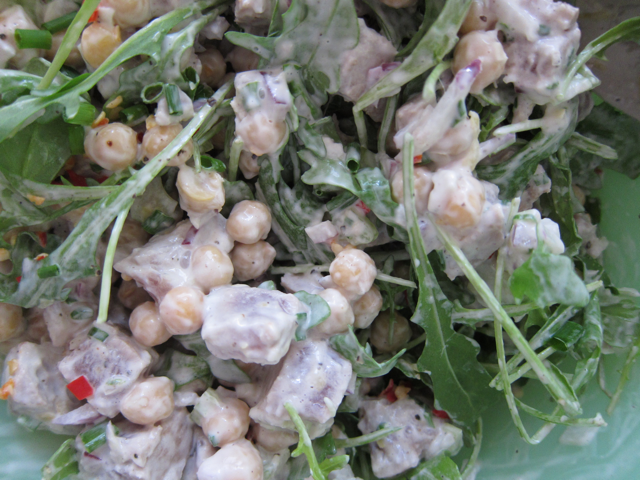
Simply slice the celeriac VERY thinly, into pieces like matchsticks. Fergus reminds us to drizzle lemon juice over the celeriac all the time you are chopping it, so it doesn’t go dark. Fold the mustard and creme fraiche together and season to taste.
Slice the beef very thinly across. Lay it on a pretty platter on a large circle, then scatter the celeriac matchsticks over, and the rocket leaves. Drizzle with the mustard-creme fraiche dressing and serve.
I know, the photo’s at the top of the post, but I thought it was so pretty, it bore posting again. Are you inspired? Thank you, Fergus Henderson. We’ll be making this one again. I also thought that a mustardy vinaigrette with rosemary in it might be nice, instead of the creme fraiche.
I’ve now been thinking of other things to do with cured beef. Always, always thinly sliced, but how about with steamed new potatoes and a pesto dressing? Or on a really good baguette with some sharp cheddar cheese and horseradish?
GORGEOUS.
What a simple, yet impressive thing to produce for your family and friends. Because John and I ate this salad ALL by ourselves, there was enough leftover for Avery to have for her breakfast, and what a success! She adored it, as it plays into the meaty-salty phenomenon she loves to kickstart the day.
But of course it’s always nice to fall back, later in the day, on some cured meat that someone else has produced. And I can promise you, this is one of the best pizzas you will ever taste: totally light and such complex flavors. It’s one of those recipes I came up with by looking in the fridge and seeing a number of things that needed to be used up, and guess what? That’s often the best recipe.
(serves 2 for lunch)
good homemade pizza crust
12 slices finocchiona (fennel salami, brought back from Florence)
1/2 cup goats cheese
1/2 head radicchio, leaves shredded
drizzle fennel oil
On a very, very hot pizza stone, place your pizza crust, then put it in a VERY very hot oven for about 5 minutes, just till puffed up and slightly cooked. Bring it out, lay the slices of salami on the crust, crumble the goats cheese over it, sprinkle with the radicchio and drizzle the truffle oil over all. Bake in your VERY hot oven for perhaps 8 minutes, just till the crust is baked and slightly golden.
Insanely good. So when you’re next feeling inspired to cook, think of… the cure.
I spent all day today in one of my favorite ways: shopping for, cooking, photographing and writing about food. Today’s efforts: peach crumble and roasted tomatoes, for my latest contribution to Vintage Magazine, out of New York next month.
Peach Crumble
(makes 4 large or 6 small servings)
2/3 cup plain flour
1/4 cup granulated white sugar
1/3 cup cold butter
6 ripe peaches
generous sprinkle fresh-ground nutmeg
even more generous sprinkle fresh-ground cinnamon
This is a lovely, light crumble, made even better if you can find a cinnamon grinder. I’ve also turned my back on ready-ground nutmeg. The aroma of fresh-ground just runs circles around the powdered stuff.
Peel the peaches, leaving the peels as long as you can, just for fun. Cut the peaches into wedge
Place the flour and sugar in your food processor and turn it on. Then, a little chunk at a time, drop the butter into the little hole at the top and clamp your hand over the hole: flour will tend to shower out the top when the butter disturbs it, the first couple of chunks. Use up all the butter and whizz until the mixture is nice and sandy. If you do not have a food processor, the same result can be achieved by simply rubbing the cold butter with the flour and sugar until well-mixed and sandy.
Cover the bottom of an ovenproof dish, around 8x6 inches, with the peach pieces. Scatter the crumble topping over the fruit and grate a sprinkle of nutmeg, and of cinnamon, over the whole thing.
Bake at 350F for about 25 minutes, till the top is golden. Serve with whipped cream.
Then there were the roasted tomatoes, too simple almost, to require a recipe, but here goes anyway.
Roasted Tomatoes with Fresh Herbs
(serve 4–6 as an appetizer with salad, cheese or cured meats)
1 lb cherry tomatoes, preferably on the vine
½ cup extra virgin olive oil
3 stems rosemary, only leaves, minced
3 leaves sage, minced
3 stems thyme, only leaves, minced
sea salt and fresh black pepper to taste
Lay the tomatoes in a single layer in an ovenproof dish. Sprinkle with the oil, herbs and seasonings. Roast in a medium oven, around 350F, for 45 minutes.
**************
All this activity was lovely, and I can’t wait for the piece to appear.
But it was all a ruse to distract me from the fact that my gorgeous teenager has turned 14. My daughter’s birthday was yesterday, and what a gorgeous, sensible, funny, intellectual, conversationally addictive person she has grown into.
We spent yesterday evening watching her open her presents: a book of photos of the cats she fostered over the summer, a gorgeous sweater from my sister, a catly locket (plus reckless spending money of course) from my parents, funny Doctor Who things from us, witness the nutty cake decoration, of course.
The Best Chocolate Buttercream Icing EVER
(makes more than enough for one cake, plus licking)
| 175g dark chocolate, at least 70% cocoa |
| 225g unsalted butter |
| 1 pinch salt |
| 1 teaspoon vanilla extract |
| 230g icing sugar |
| 1 egg |
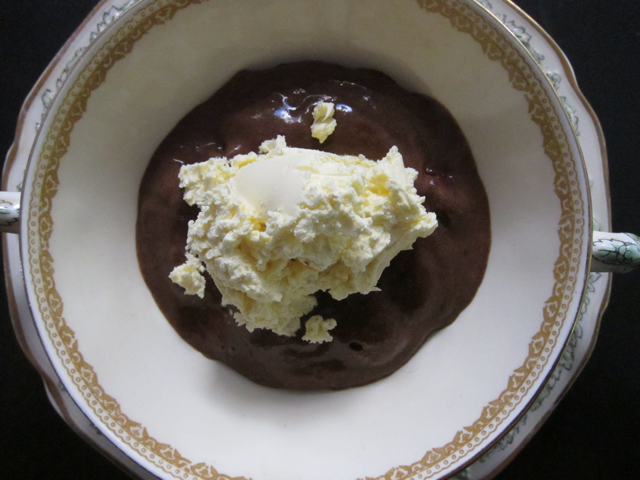
Melt the chocolate in a double boiler. Meanwhile, beat the butter with the salt and vanilla extract with an electric mixer — bear with me, it’s very boring from here on out, just KEEP BEATING — till airy and light, seriously 4 minutes or so. Then add the icing sugar a bit at a time — it’s very dusty — and keep beating another 5 minutes as you incorporate it. Then add the egg and beat another bloody 5 minutes, and THEN add the chocolate, slightly cooled. And then, trust me, it’s really worth it.
Glossy, smooth, chocolately. And I don’t even LIKE that kind of thing.
*******************
We celebrated with memories of the extravagant shopping trips with John’s mom in Florence where she kept repeating, “This is REALLY the last present, I promise!”…
We looked through the photo albums, as we always do, at pregnant me, at tiny baby Avery, and toddler Avery with her Grandpa Jack who I am absolutely sure is, somewhere, vastly proud of who she has become. He must look at her with her sensible, darling girlfriends, her beautiful table conversation manners, her Russian vocabulary and her flapper bob, and most important, her gentle love for her grandmother, and think somehow, “Yes, I knew she would become just exactly THAT person.” I know he will continue to watch, because she’s worth watching. We won’t forget.
Happy Birthday, Avery.
And so Day Three of our Florentine adventures dawned, pouring with rain. We decided to cross the street and visit the Pitti Palace, and dear readers, given the choice, I would definitely wait for a sunny day, skip the seemingly endless room after room of painting after painting and go instead to the Boboli Gardens, adjacent to the Palace. The only truly memorable thing about the Pitti Collection, for us that day, was the discovery of what I now think of as “The Number One Way I Don’t Want To Be Martyred.” Poor Saint Agatha.
But at least we did get the view, above, of the clearing sky around lunchtime, and we left our cultural advancement behind in order to feast on our market takings, back at home.
I have been trying to find, in my little Italian dictionary, what the word was that the baker was using when I bought this bread. It sounded like “sketchy,” but I cannot find it, really. It was like a very crusty, salty focaccio. Since we had lost the battle of No White Food already with the flour in the spinach dumplings TWO nights in a row, it seemed the better part of valor to eat this lovely bread, with our cheese and salami.
And then the skies cleared, and since the apartment was to open as the Barret-Browning Museum that afternoon, we decided to get ourselves to Santa Croce, a la “A Room With A View,” one of my favorite all-time books and films. And it was just lovely.
Dear Michelangelo’s tomb! Designed by Vasari, which I had forgotten. I really must encourage Avery to read his Lives of the Artists, one of the best, most gossipy takes on Florence in the Renaissance that you could wish for. He knew everyone, and believe me, what happened in Florence did NOT stay in Florence. He told all.
We wandered around in the patchy sunlight, looking at all the plaques and tombs to various people of note: Marconi, who invented the radio, and Machiavelli, there are a couple of strange bedfellows! And Lorenzo Ghiberti, he of the golden doors on the Baptistery, and Dante! Sadly the Giotto frescoes were in restauro, which is one of the hazards of visiting Florence. When I lived there for a summer, 25 years ago, it seemed we were constantly walking all the way across the city to see some chapel or other, only to find it chiuso when we got there. Avery pointed out that, “Fair enough, it’s been 25 years, they probably NEED restoring.” I could use a little touching up myself.
From Santa Croce, we escaped into bright sunshine and mutually decided that for the moment, we were both art-ed out and church-ed out. Avery was aiming for some gelato, and I had some serious food shopping to do.
This shop, in a tiny, winding side street, the Via Dei Neri off the piazza Santa Croce, had everything! Balls of homemade mozzarella di bufala, creamy and almost falling apart, olives of every description, the most expensive tuna in olive oil I have ever come across — 12 euros for a jar! — and an enormous, towering rack of spices in glass tubes corked like wine bottles. And a gorgeous prosciutto, not too salty. And jars of fagioli, the white beans so much more delicious, simply sauteed with olive oil and garlic, than any bean living in England. Why? Because everything in Italy tastes better than anything anywhere else. It’s in the air.
We came home laden with parcels — fresh artichokes and firm heads of finocchio, fennel, with which I proposed to make a salad. And when I cut into the first artichoke, look what I found… or rather, “who.”
What a lucky fellow, that I didn’t cut him in half! I shrieked! Everyone came running. “You must put him outside somewhere, Mummy!” Avery wailed, so I went to show him to Elena, the lovely housekeeper who was acting as docent in the museum that afternoon. “Where shall I put him?” “There is a potted lemon tree outside your bathroom. He can go there. And don’t worry: you can still eat the artichoke!” she assured me, 100% Italian. Well trimmed and washed, it made a lovely salad, and the caterpillar earned his siesta in the lemon tree.
Meanwhile, the wild boar stew bubbled away. Following the restaurateur’s instructions of the night before, the chunks of gorgeously marbled meat had reposed, overnight, in a bath of red wine. Now, it filled the apartment with its garlicky aroma.
Stufato di Cinghiale
(serve 4)
1 kilo/2 lbs wild boar meat, cut into manageable chunks
1 bottle adequate red wine
leftover tops and leaves of 2 bulbs fennel
1 white onion, quartered
6 cloves garlic, crushed slightly
olive oil to cover bottom of cooking dish
1 lb chestnut or white mushrooms, quartered
2 cups beef or chicken stock
1/2 cup panna al tartufo, truffled cream, if you’re in Florence: ordinary cream if not
dash truffle oil
Wash the meat and dry it with paper towels. Place in a heavy-bottomed dish large enough to contain all the ingredients. Pour over the wine, then throw in the fennel tops, onions and garlic. Leave in fridge overnight, covered.
Six hours before you are ready to eat, drain away all but about 1/2 cup of the wine, leaving the vegetables in the dish with the meat, then add the mushrooms and the stock, to cover the meat.
Cook at a very low temperature, perhaps 200F/100C, so that the meat bubbles slightly, either on the stovetop or in the oven, for six hours. Check to make sure the stew is bubbling constantly, and stir occasionally.
When the meat is thoroughly cooked and tender, add the truffle or regular cream and the drizzle of truffle oil. Serve with noodles or bread.
**************************
While this stew was very good, I do not think it bubbled quite consistently enough in the oven while we were away, because I was so intent on having the oven low. As a result, the meat was a bit tougher than I would like, not the melting quality of my shoulder of beef cooked much the same way. It’s also possible that wild boar is simply tougher. I have one rather famous cooking friend who says he’s never cooked it to his complete satisfaction. But he keeps trying, because the flavor is so lovely. Not a big gamey, but a big, meaty flavor that went perfectly with the mushrooms and cream
And to start, we had a truly Italian appetizer: mozzarella di bufala with shaved truffles, and a drizzle of truffle oil. So simple, so perfect.
Sighs of delight all around, in the tall-ceilinged dining room, where we felt like visiting royalty. Out for gelato in the Piazza de la Signora, with all the other tourists, which can be fun if you just forget how much you’d like to fit in, and live there… and home to fall exhausted to sleep, with the motorbikes screeching outside the windows, the sounds of far-off music, voices shouting in Italian too fast to be understood. Heaven, in short.