I have been enjoying a little respite from remembering, self-examination, and the dredging down inside for ways to tell of our experiences ten years ago. I am terribly grateful to all my wonderful readers who assured me that I had been able, finally, to express what I intended to express. As unlikely as it sounds, as soon as I pressed the “publish” button on my beloved blog, I felt a real weight off my shoulders. I flexed my muscles, took a deep breath, and felt completely prepared to let go of these experiences and memories, and to return to the ordinary business of living — and being me, writing about living.
Why do people want to write, anyway? Well, I turned as one should always do in these situations, for wisdom from great writers. Foremost among them for me is the inimitable E.B. White, author of countless humanist essays, endless articles for the New Yorker magazine, and for me most importantly, of “Charlotte’s Web,” possibly the greatest children’s book of all time.
E.B. White tells us two challenging things:
What did we learn from September 11?
I learned that nothing, whether it is bad or good, lasts forever. After the events of the day, that truism seemed to apply only to good things: skyscrapers, happy kindergarten, safety, security.
But as the months went by, I learned that the bad bits do not last forever, either. As a lovely Scottish writer put it, “Grief is a wonderful thing in a way, because after a bit you can put it down, by the side of the road, and walk on.” I learned to do that, but it was slow-going and with many steps backward along the way. I learned that in many ways, I was made of The Wrong Stuff. I could not be farther from the personality of a hero who runs into a burning building or a mayor who goes to 343 firemen’s funerals, or Abby the Kindergarten Teacher who spent seven hours a day with 45 five-year-olds and was still smiling at 3 p.m. I just was not made of The Right Stuff.
I empathized with the editorial writer of the New York Times who mused whether she would rather die smothered in a tunnel or falling from a bridge. I worried a great deal about vehicles parked in my street with no immediately identifiable owner. The whole “if you see something, say something” motto of New York City found a willing collaborator in me, and my local precinct of New York’s Bravest got heartily sick of my phone calls. I’m sure I was on a “loony neighbor” list with the box next to my name firmly ticked. In ink.
I took a lot of fitful naps and became obsessively familiar with the topography of Afghanistan. I was irritable and snappish. I was not inspirational or uplifting or even one iota optimistic.
But the thing was, life was relentless. Coping with Avery’s needs got me up in the morning and kept me going during the day. It was impossible not to get excited when the classroom chicks hatched, and even though there wasn’t a place to sit down, the kindergarten room was a magnet for many of us parents. Abby’s unfailing, gentle smile was always filled with love and patience, for all of us. We parents often felt as much under her wing as the children did.
And then, in February, it happened. Our beloved PS 234 was given back to us.
The Federal Emergency Management Administration had occupied the school since the evening of September 11. On the school’s website there was a calendar with a smiley face stuck to every day the school had been open that year. It stopped at September 10. Who knows what state the school building was in when the last of those official boots walked out the door. We kindergarten parents were not included in what must have been a massive parental effort to make the school welcoming again.
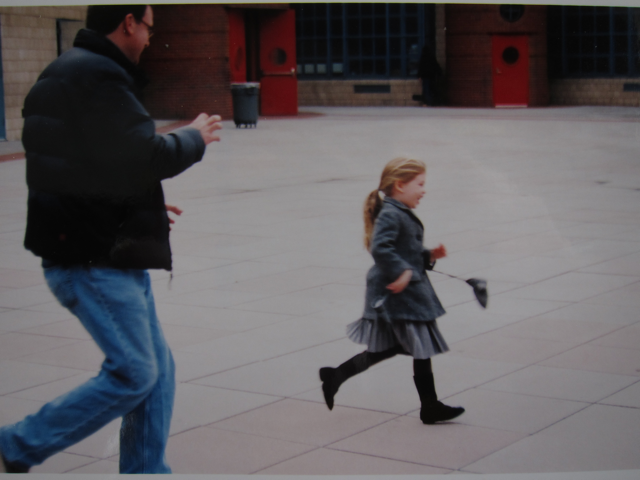
What I do remember is the open weekend before the official reopening on Monday, February 4. With characteristic sensitivity, the school’s administrators simply opened the doors, all weekend, and let us all re-acquaint ourselves with the school in our own time, in our own ways. All Avery wanted to do was run around “the yard,” the seemingly unappealing, simple concrete open area which had been the scene of such panic and chaos months before. In the months and years ahead, “the yard” would be the scene instead of hours of chalk-drawing, whispered confidences, kickball and even a little childhood romance… Around and around she ran, exorcising ghosts.
There were huge trucks parked outside the front door of the school, loaded with fresh school supplies, juice boxes, probably even a hamster or two. It was very, very exciting, and also heartbreaking in a way. Starting over is always a challenge, and we had started over so many times that year.
We went inside and for some reason were the only people there. The solitude and silence were just what we needed to absorb the memories of the past, to reconcile the hope and innocence of September 10 with the experiences of September 11, the adjustments, tears, losses and gains of the intervening five months. The quiet hallways were lined, poetically, touchingly, with the dozens of American flags made of every material you can imagine, from countries all over the world, sent to us to cheer us up on arrival. “Welcome home!” they said in many languages. “You’ve got your school back! Hip hip hooray!”
Avery stood gazing up at one of the dozens of quilts that had been sent to us, reading the heartfelt, empathetic messages from children we would never meet. “I know it’s been hard for you, but it will get better.” “The whole world is thinking of you.” “We had a hurricane in our town once and three people died, so I know how you feel.”
It was stunning and humbling to think of all the effort, all over the world, that strangers had made to create gifts for our children (and for us), to hang in our school. I thought of all the schoolteachers who felt helpless, imagining what they would do if their school were taken from them, and it must have felt so good to be able to do something, to give us something. They were such interesting donations: not commercial or monetary or valuable. They were simply outpourings of sympathy, and we needed them.
Of course there was one tangible gift that became part of Avery’s life and has followed her everywhere. Abby Bear.
Abby Bear — dozens of Abby Bears — were sent to us by a school in Alabama, and distributed to all the kindergartners. She has moved with us across an ocean, and to three London homes. Something tells me she’ll be making the trip to university in four years’ time.
On our way home from the quiet tour of our school, I asked Avery, “What do you remember from that day, September 11? Do you remember anything special?”
Long pause.
“Well, I remember that I was the last one in through the red door. And then, there was a very loud noise, and all the pigeons flew in the same direction.”
So we went back. That Monday in February, a cold and bitter day, there were many odd things to notice. Cheerleaders! A marching band from the local high school! Hundreds of reporters, among them a lovely writer from People Magazine who included us in his story. The chancellor or commissioner or whatever he is called, of Education turned up, the president of the PTA at whom I had so unhelpfully cursed on September 11, made a speech. Finally our beloved Anna Switzer, the most formidable and yet warm-hearted principal any school will ever know, welcomed us.
I don’t remember anything anyone said because I was too busy trying not to cry. Unsuccessfully. Everything to do with Avery always makes me want to cry, but it was a bit more so that day even than usual. I looked at Anna Switzer and wondered how she had survived the last five months: the worry, the pressure, the controversy over the air quality — should we or should we not return? — on top of the usual problems any school has, like never enough money for anything. Anna was indefatigable. When she discovered that Avery, a lowly kindergartner, used handkerchiefs instead of tissues, she gave her one. “I collect them,” she explained. Avery has it still. Perhaps it was in her pocket that day.
Throughout the speeches, I felt myself disintegrating a bit inside. Here was the day we had all been waiting for! Why wasn’t I completely happy? I think there was a lot of anger underneath my general worry and fear, anger that made it hard to get to the celebratory bit. How monstrous it was that we should be forced into this situation at all. How unacceptable that we should have to stand there, feeling tearful and grateful and thankful and SPECIAL. Why should John have to spell out “PS 234″ in raisin toast for Avery’s birthday? I was suddenly in the mood to throw a bowl of cereal at her in the morning and get back to being casual, and ordinary.
But we got through the ceremony. Abby gathered up her charges, in all their human variety and small stature. That kindergarten class was her first ever job.
Finally they went into the school, through the red door. Avery was gone. School was open. And nothing bad happened.
We soldiered on. I discovered what it was like to be part of the PS 234 community. The PTA — a much more bossy and vocal group than our English school’s “Parents Guild” — ran the place. We raised tens of thousands of dollars to provide our school with a library, where I worked from Day One, labelling each and every book with a barcode so the collection could be computerized, for the first time. This was the view from the window of the library.
Only if you had been there before September 11 would you know that you shouldn’t be able to see any sky from this window. There should be only the buildings, as far, really, as the eye could see. These trailers and trucks down below housed emergency workers well into the summer that year.
During the days I spent barcoding books, there were surreal moments. An announcement over the loudspeaker. “The kindergarten trip to Staten Island has been cancelled due to a bomb threat at the Statue of Liberty. Pickup at normal time today.” There was Laura Bush’s visit to read to the children, a visit complete with escorts from the National Guard, carrying rifles and automatic weapons into our school.
But in general, something like normal life prevailed. We held the annual Spring Auction which raised money for the art and music departments. I became the head of the Book Sale which took place every semester in the very hallway where we all had stood, wondering what to do, on September 11. In that same hallway, I read with children who were having trouble keeping up. (Actually mostly what I did was listen to childish chatter as the kids would much rather gossip than read aloud.) I was class mother, so I went on countless school trips to arboretums, zoos, museums. Gradually our memories of the school as a place of horror and uncertainty became replaced with cozy, messy, shouty memories of kids with sticky hands. Avery became used to seeing me at school, in school, nearly every day. It was the only way I could think of to cope. It was a bit of a cheat really: I was in theory “leaving her at school,” because I left her in the schoolyard and kissed her goodbye. But I was there.
One day John told me something he hadn’t wanted to tell me before. He had been invited to a financial information services breakfast at “Windows on the World,” the restaurant at the top of the World Trade Center, on the morning of September 11. He had decided he was too busy to go. Everyone there died.
These adjustments and experiences and memories had unexpected effects on me, perhaps on all of us. I had my first and only ever borderline suicidal thoughts. Not that I really wanted to be dead, but sometimes the overwhelming preciousness of being alive, and the lingering fear of how much we all had to lose, overwhelmed me. I imagined, briefly, how much easier it would be just to throw it all away myself, take the bull by the horns, just give in, give up. At times like that I decided to think it was a normal stage of grieving, and I retreated under a duvet with a pile of cats, an old familiar video on the television, and waited out the day until it was time to pick Avery up at school. Seeing her again always made the unspeakable fears retreat, for a time.
Summer came. We all went back to playing in the park across the street from the school, where one scary evening in winter a team in Hazmat suits had come to vacuum up the sandbox. That’s how crazy life was in the months after we went back to school. Some city official would wake up in the middle of the night and say to himself, “Oh my God! That sandbox! There could be ANYTHING in it. Quick, get rid of it. Maybe no one will notice us there.” And we’d wake up to a brandnew, cleanly filled sandbox for the first time in living memory, when for sure neighborhood children had been squatting there and doing who knows what for years.
That same official, responding to the pleas of still-upset parents, installed some sort of magic air-measuring balloon at the top of the schoolyard. Every once in awhile, there would be no “yard,” what we called “recess,” because some number measuring something had been too high, that morning. Now, in hindsight, I think so many of these “official” measurements and actions were a sort of “pay no attention to the man behind the curtain,” as we all vaguely hoped some Wizard was looking after us.
There were, once again, birthday parties in the park, however. Ice cream and cake wait for no man.
On the last day of school that year, the hugs and kisses were fervent. We said goodbye to Abby who with her personal brand of emotional glue had held us all together, individually and as a group, since September 11. The new school year would be a fresh start, another “first day of school.”
Every year we observe the anniversary, in small ways. We watch the names being read on television. Alyssa called me the first year. “They were on the Cs, and I had to go to the grocery. When I got back, they were only on the Ms.” Every year I speak in an email to Jen, the mother I stood with on the corner when the plane went over. I speak to Kathleen, Cici’s mom, with whom I shared the whole terrible day. Every year I speak to my friend at Cantor Fitzgerald, a little about September 11, a little about art. Here in England we go to the beautiful memorial to the 67 British victims, in Grosvenor Square where the American Embassy looms.
Every year we ask Avery what she remembers and somewhere along the line, the memories (as few as they were) went from real memories to only stories being told about what she remembers being told she remembers.
This spring, out of the blue, the phone rang here in London as we were still unpacking boxes from our latest move. “Hi, this is Doug, from that Canadian newspaper who interviewed you and Avery in November, after September 11. Do you remember? You showed me the hat you bought for Avery from the Afghan store in New York, during the first part of the war. Do you remember?”
Suddenly I did. I told him I’d call him back, scrambled to my feet, ran up to Avery’s room at the top of the house, rooted through her closet, and finally found it.
I called him back and he asked many questions about how we had coped in the years since that day. Avery overheard my half of the conversation and came into the room after I had hung up. “Do you guys realize that I know less about September 11 than anyone else my age? I was the only one who was there, and I don’t know anything about it! It’s probably the most interesting, significant thing that will ever happen in my life, and I was left out of the whole thing.”
(My friend Elizabeth smiled wisely when I told her this story. “We hope it’s not the more interesting, significant thing what will ever happen to her.” I smiled more grimly and said, “Maybe we don’t. Maybe that’s as interesting as it needs to get.”)
“You were four years old!” I said, immediately defensive. “You didn’t have any business knowing anything about it. You were a baby!”
We talked about the day, what had happened to her. “I remember the school was REALLY crowded!” And of course she remembers Abby.
“Go ahead and find out anything you like,” we said finally. Avery is an inveterate news house, addicted to the BBC and vociferously well-informed about all current events, much more so than I.
We will never know if it was the right thing to do, to protect and shelter her. Children are resilient, everyone always tells me. People in general are resilient. One thing I certainly learned from September 11 and the days and months and years afterward is a sort of modified Nietzsche truism: “That which does not kill you does not necessarily make you stronger, but you are still alive. Get on with it.”
We continue to try. On this anniversary my greatest hope is to remember, then put the memories down by the side of the road, and walk on.
(click here to read of what happened to us on the day of the events)
On September 10, 2001, we got up early in our Tribeca apartment because it was the first day — only a half day, but still, the first day — of kindergarten for Avery.
I pretended to be as excited as she and John were, as she burbled on about finally being in “real school,” about her new shoes, about finally, the next day, staying in school to eat her lunch.
I, on the other hand, had spent the entire summer thinking I was dying of something. Not sure what, but sure something was drastically wrong with me, I haunted doctors. I went to my GP several times, who promised me, “You’re fine, and even if you’re not, whatever it is, we’ll fix it.” From there I saw a gastroenterologist, an endocrinologist and was about to see a neurologist when something eye-opening happened to me. I picked up Avery at summer camp one afternoon, and realized that all my symptoms– a pervasive stomach-ache, slight tremor in my hands, rapid heartbeat– disappeared as soon as I had her hand in mine. I went home, tore up the reminder for my appointment with the neurologist, and set myself to the task of learning to say goodbye to my little girl, to leave her at school like all other parents leave children at school. I was suffering from pre-separation anxiety, not a brain tumor.
That first half-day of school I felt like the world was coming to an end. Since she was a baby, Avery had gone to “preschool,” a sweet little Montessori morning activity with her best friends Cici and Annabelle, trying to become socialized, to let other people talk, to share, all difficult tasks for an adored only child both of whose parents turned instantly toward her the moment she opened her mouth. I knew that all-day real school would be even better for her. She had never looked back for me when I left her at preschool, only turning resolutely toward her real life, happily leaving me behind. I was the one with the problem.
John and I took her to school, or rather she took herself, that first half-day of kindergarten, bouncing down the sidewalk with Cici, who lived in the same building with us. They could not have been more excited. She was so adorable, so pure and priceless, that we took lots of photographs. Here she is outside the gate, wearing the special new outfit she had planned for days. Especially the beret.
And the red shoes, which made little clicky sounds on the sidewalk as she skipped along.
Into the school she went. I spent the morning trying to think of what I was going to do with my year, what every parent thinks of as the year from September to June. I had quit my teaching jobs the last year in order to write a book, and it was nearly finished, only waiting for museums to give permission to use their images. It would keep me busy.
The half-day ended and I went to pick her up in the little concrete schoolyard surrounded by the wrought-iron ornamental fence, a fixture in our neighborhood. It was a coveted school, that rare thing: a New York public school that was safe, supported by parents, cozy and successful. I was surrounded by other mothers, by fathers and nannies, waiting for the children. The sky was dark with heavy clouds, the air so humid it pressed against our faces like a wet washcloth, tiny drops of rain began to sprinkle onto our heads. Suddenly there was a CRACK, a shocking CRASH. We all jumped a mile high, then looked sheepishly at each other, laughing at our silly panic, as the heavens opened and the afternoon dissolved into a thunderstorm.
At last the doors opened: the big front door to the school where the older children came out, and the little red door onto the schoolyard where the little ones were shepherded out by their loving teachers. And there she was. “I LOVE Abby! She is the nicest teacher! And we colored, and we’re going to be studying chicks! And how they turn into chickens!” Avery’s words tumbled over each other as I picked her up, a feeling of deep relief showering me, lowering my blood pressure, making me sigh with happiness. Everything was going to be FINE. Why had I dreaded school so much? She had had a wonderful morning.
She was so earnest, so concerned about fitting in and doing the right things.
That night the clouds rolled out, the temperature dropped to a perfect September nip. The next morning, the first full day of school, dawned famously blue and perfect. I don’t have to describe it because it is its own category of day now, “a September 11 kind of day.” It was the second day, so no more fancy clothes. She put on a yellow t-shirt and a little full skirt with appliqued pink and orange fluffy flowers on it. John didn’t come with us. Having his own life to attend to, he headed to work in Times Square and I headed down the three blocks between our apartment and the school, handed her her lunchbox (Hello Kitty), gave her a hug and kiss. “See you at 3 o’clock!” I said, and watched her cavorting in the schoolyard with the children who were already her friends. We were early. It was just after 8:30 a.m.
I caught up with a mother I recognized as having a little girl in kindergarten, and we walked together uptown, she pushing her little boy in a stroller. “Jen, are you at all nervous or upset at Tova’s going to school all day?” I asked, feeling foolish but as usual wanting to see if someone else shared my experience.
“Are you kidding, with this little guy to entertain all day? I’m thrilled,” she said. We went on chatting.
“What? What did you say?” I shouted.
“I can’t hear you either,” she said, and as one person we looked up into the sky. As we stood there, on the corner of Duane and Greenwich, the school a block and a half away, a plane approached overhead.
“Are planes allowed to fly that low in Manhattan?” I shouted.
“No! And he’s headed straight ahead! How can he not see where he’s going?”
“He still has time to turn!” I shouted, as I strained to see what was to the right of what we now refer to as “the North Tower” or “Building Number 1″ but what in those days was known by us locals simply as “the World Trade Center.” We hardly thought about there being two buildings.
“He’s not turning! Oh my God!”
And then I experienced a trick of perception that I thought about only later. First, time slowed down as I watched the airplane simply park itself into the building, high above our heads. In my perception of that moment, there was no sound. Despite the enormous, overwhelming, ear-crushing explosion that was occurring before me, in my world, everything was silent. The airplane simply silently parked itself into the side of the building. And then there were flames.
“The school!” Jen and I screamed together. As we looked toward the school, the several city blocks that separated it from the World Trade Center telescoped into nothingness. There was just the shower of flames, and directly below, our school.
We ran, she awkwardly pulling and pushing the stroller. “Oh my God, Oh my God,” we panted over and over. We reached the school; the schoolyard with its red door was empty, the gate locked. We went to the big kids’ front door. Parents were shouting and pushing. The president of the PTA, also on his first full day of school, blocked the entrance. “Now hold on, the fire department is coming. Everything will be taken care of. The safest place for your children is in this school building.”
“Get the f***k out of my way, I need my daughter,” I said quietly, and he just as quietly stepped aside. We rushed inside, looking for our children in a building we weren’t very familiar with, had visited only a couple of times. “Where are the kindergarten rooms?” I asked some poor teacher who looked completely shell-shocked. “Avery is right in there,” she said immediately, although I didn’t recognize her. I went in. There were other parents there and a frantic rush to find our children.
Then a realization swept me. I was the adult. I was the parent. I was not with peers with whom I could share my fear. I was the one who had to look in control, calm and adult. It was the first and possibly only truly rational thought I ever had, during the events of September 11.
“Hi, Avery, there’s been an accident outside and we’re going home. Where’s Cici? She can come with us,” and then there was Cici’s father John, so we grabbed the girls and their lunchboxes and headed downstairs to the exit. Once in the round brick rotunda that held the welcome desk, however, we felt wracked with indecision, so many parents and children, crowding the small space. “Should we leave? Or would it just be better to leave things normal?” we all wondered aloud in various ways. Then came a terrible sound, both deafening and eerily muffled by the round brick room in which we crowded. “What the hell…?” We all looked at each other with an indescribable combination of fear, dread, unknowing, and yet knowing. The second building had been hit, by what, we did not know.
“We’re getting out of here,” I said and I carried Avery out. Instantly I realized I needed to walk a certain way, to hold her head against my shoulder a certain way so that she could not see whatever was happening behind the school, in those buildings four blocks away. We emerged into the perfect blue-sky day to find parents frantically shaking cellphones which no longer worked (I did not even have a cell phone in those days), parents crying, holding onto each other, parents vomiting into the curbs. I walked as quickly as I could toward home, three blocks away, uptown, away from the World Trade Center.
We arrived at home in silence, Avery somehow having divined not to ask questions. It was the first of the many moments after that day that she showed the sensitivity and maturity that have become the hallmarks of her personality.
We sat, Cici’s mother Kathleen and I, on the bench inside our apartment, holding the girls’ lunchboxes, then putting them down, then holding each other’s hands. There was nothing to say. The girls themselves ran off to play, a bit confused as to the shortened school day, but happy to be together.
Finally I said, “Do you remember that time at dinner once, when we all wondered where the top of the spire of the building would land, if it crashed down sideways?”
“Yes.”
“And we found out it would crash right through our bedroom windows.”
“Yes.”
The elevator opened into our apartment and there was John, panting, sweating. “I saw the second plane go in from Times Square, and got a cab down to 14th Street, then ran home from there.” It was about 40 blocks. Kathleen’s husband John arrived and the two men went up to the building’s roof, while Kathleen and I took the girls up to her apartment, the sixth and top floor of our building, and sat silently together. Suddenly John and John shouted from the roof, “Oh my God, the building is going. We’re getting out of here.” We grabbed the children — Cici and Avery and Cici’s little brother Noah — and rode down together in the elevator, emerging into the ridiculous sunshine to head uptown as fast as we reasonably could. A young lady emerged from nowhere, holding a baby. “I came out of our building holding the baby and now they won’t let me back in! I need his food, and diapers! I have no money, no house keys, nothing!” “Come with us,” we all said, and scooped them up.
We walked, walked, walked until we came to Cici’s father’s office building on Canal Street, and rode up in the elevator to his newspaper offices, which were teeming with reporters, this sort of thing being their raison d’etre, however horrifying at the time. Everyone was on computers, on the phone, shouting, gesticulating. We came in holding the kids and headed toward an empty conference room, unconsciously, I think, looking for a room in the center of the building, not at the perimeters. The room was decorated with a photograph of the 1930s Manhattan skyline, dominated by the Empire State Building, looking down to a low, flat downtown. “We’re back there, now, if the second building falls down,” Kathleen said.
And it did. John was outside in the dust, having begged me to let him go down to the site and help. I shouted, “No! Your place is here with us!” I simply could not contemplate his going down to the site. I hadn’t even begun to worry about the air quality, what he would breathe in if he went. It just seemed unbearably tenuous and unknown to let him go. So he didn’t. To this day, every anniversary, he expresses his doubts about staying with us, about not helping. But I could not let him go down there. So he was out buying diapers and baby formula for the strange baby and lady in our midst, when the second building fell.
I remember sticking my head out the window to look at the smoldering, smoking skyscraper one moment. The next moment when I looked, it simply wasn’t there anymore. It sounds ridiculously simplistic to say it that way, but that was how the day progressed. Buildings simply disappeared.
Then it was a blur, the rest of the day, imagining that the sky was full of other plane-weapons, imagining other targets. We heard there were seventeen missing planes, twenty missing planes. No one knew what to believe. The children played nearby, oblivious. I thought, “What were we thinking, having a child in this world? How dared we bring an innocent baby into this world.” Our thoughts and fears turned to the most basic a person can have. Months later, John and I took some sort of online survey about Post-Traumatic Stress Disorder, then not really a syndrome common enough to have an acronym, PTSD. One question was, “Did you at any time during your experience fear for your life?” It seemed unbelievable that such ordinary, unremarkable people as we, on a blue-sky day in Tribeca, could answer, “Yes.”
John successfully battled his way down to our apartment that afternoon, past the guards, the police and the military, and let himself in to immediately hear the buzzer, over and over. There were policement and firemen who had survived, desperately seeking water, a bathroom, a moment of peace. My mother remembers our telling her that one fireman took a long drink of water, looked around our untouched apartment and said, “Bamboo. I’ve always wanted to do a floor in bamboo… I can’t believe I’m talking about your floor, on a day like today.” “We have to try to talk about things like that,” John assured him. “That’s life.”
John came back up to get us on Canal Street and we all came home, crowding into our apartment because, being me, there was food. Everyone in the building came, all five floors of us, plus the Lady and the Baby, as I think of them now. And at some point in the evening, her husband appeared in the elevator, having walked all the way from LaGuardia airport where he was stranded. They went home. The rest of us stayed, eating meatloaf, ribs, cream of something soup, whatever we had in the fridge. And on that night, around our dining table, was born my most powerful amulet against the overwhelming fear, the existential fear, that had been created that day. Whatever happened, it would be better if “everyone” were together. From then on, I think, I’ve felt better the more people were gathered around my table.
That night no one, none of the adults, could sleep. Because we had not let her see what was happening behind her school, because intermittently for various power reasons we had no television or computer (and for some time after that, we deliberately kept her away from the television), Avery was completely sheltered from what was occurring outside her door. Our street was the first above the disaster that retained electric power. And so we stayed, through the unspeakable night of the 11th. I moved from our bedroom to the living room where I lay on the sofa, contemplating the unfathomable wound in our beloved city, our cherished neighborhood, the loss of our security, the loss of our school, the near-loss of my child, as I saw it.
The next day we all tried to live. I remember speaking to my best friend Alyssa on the phone; she was cleaning out Annabelle’s closet. Why on earth are you bothering, I thought. We won’t be alive long enough for you to care. Later that morning I received an unbelievable telephone call. A dear friend of mine who had worked as art curator for Cantor Fitzgerald, whose dead accounted for 25% of those lost, had been delayed in going to work on September 11. Her alarm didn’t go off. She was still here, still with us. Somehow her being saved only frightened me more; the randomness was almost the worst. “You won’t believe this,” she told me, “but a totally intact memo from Cantor just floated into my backyard.” She lived in Brooklyn.
The neighborhood showed the scars. An empty space where the buildings had been just blocks from our house. I described it to Avery as “a big mess you’ll see at the end of the street, but they’ll clean it up.”
Our poor old local McDonald’s.
And boxes of fruit covered in that toxic, memory-and identity-laden dust we could not contemplate, simply had to live with.
I do not do well sleepless. By the morning of the 13th it was clear that me sleepless was not viable, and at the same time, our beloved friends Livia and Janice in New Jersey had been begging for us to come. I called Alyssa, since we did not have a car.
“We are heading out to Seacaucus, so pack up those crazy cats and come with us.”
It was the work of a moment to pack the crazy cats up, throw some of Avery’s belongings in a suitcase, and head to Alyssa’s, two blocks up. We squished everyone into her car, and drove toward the George Washington Bridge, passing an extraordinary sight: hundreds of people, just ordinary people, lining the divider between the uptown and down lanes of the West Side Highway. They faced the lane going downtown, toward the site, and held up hand-lettered signs reading “You’re our heroes, FDNY!” “FIREMEN ARE ANGELS” “GOD BLESS THE USA”.
Alyssa’s dysfunctional dog Sidney cowered on the floor of the front seat. We all rode in silence, not looking behind us. Then as we crossed the George Washington Bridge, we could not help ourselves. We turned around.
The black and gray swirling cloud caused by the falling of the two towers, palpable on some terrible Richter Scale, visible from the Hubble Space telescope, loomed in the distance downtown.
“Where is our city? Where is our neighborhood? What has happened to us?” We all asked everything at the same time.
And at that very moment, every cat in the back of the car chose to behave as if there were a litterbox back there.
“Whew! Oh my goodness…” and then Sidney’s snout, too fearful to rise above seat level normally, appeared like a little submarine spotter. “What on earth are those cats doing?” It was a moment of hilarity we all needed, to survive. And yet when our car passed by groups of men playing golf in the New Jersey sunshine, I was so angry I could hardly breathe. How dared they? Now I wonder if I dreamed that memory. Was anyone in the tri-state area really playing golf on September 13?
We arrived at Livia’s and Janice’s house and simply collapsed in their arms. Never had their pristine, white, perfect house in New Jersey seemed such a sanctuary. We stayed until September 15. I spoke on the telephone often with our families in the Midwest who were worried about us. Avery riffled through Livia’s childhood closets to find the dolls she always played with there. We drank far too much Scotch, stayed up until the wee hours of the morning, trying to make sense of what had happened. Livia sat on the edge of my bed the first night, stroking my hand. “I think our world is ended, Livvie,” I said. She held me. “It will come out all right, you know. It always does.” After a decent sleep, I felt better, but the resumed airplane flights overhead after the several days’ quiet did not help. Other people celebrated the return of planes to the sky as a sign that normal life was returning. After my experience, planes in the sky did not feel normal. Even now, I have an instinctive drawing-back when I hear or see or feel an airplane overhead. I am quite certain that that reaction will last all my life.
On September 15 we went home. The neighborhood had pulled together, as we shortly realized was just in our neighborhood’s nature. I will never again live in a place of such human warmth, generosity and common love. We had two Rocco’s: Rocco of our beloved Bazzini’s, the ancient nut and coffee company on our corner, put up a lovely sign saying many simple, reassuring things, among them, “We will rise above this and emerge stronger and closer than ever.” Rocco of our beloved “Roc” Restaurant simply brought his kitchen out to the sidewalk and fed us all, firemen, policemen, newspeople. Those of us who knew him who lived there in our streets with his restaurant, paid everything we had on us, in thanks for the love and sustenance.
On September 19, a week and a day after the events, Avery went back to school. Her school, our beloved PS 234, had been requisitioned by FEMA and was occupied not with schoolchildren but with boxes of size 11 boots and firecoats, clipboards and rapid-response telecommunications units of some kind. We prepared Avery for the “new school” which was in fact going to be a very old school, PS 41, already overcrowded and now set to welcome an extra 50% of students from the evacuated students from all over lower Manhattan.
Before we took her to school, I sat Avery down and asked her what she knew about what had happened. For better or worse, our joint parental decision had been to keep the television off, no newspapers, magazines, and no discussion of what had happened until she was in bed. But we could not let her go to school with both her old classmates and dozens of new, strange children, with no knowledge of the events.
Avery, with her characteristic intense dignity and personal reticence, even at just four years old, said, “I know the World Trade Center is gone, because you told me. What happened to it?”
“A plane flew into it and started a huge fire, and then it collapsed. Now they’re cleaning it all up before they can build something new there.”
A pause, then Avery said, “But weren’t there TWO buildings?”
“Yes. And there were two planes.”
Another pause, then she said, frowning, “That begins to sound like not an accident.”
“No, it wasn’t an accident. Some very evil people who were told to hate our country flew the planes into the buildings deliberately.”
“Why would anyone hate our country?”
“Because we are very free to do and say what we please, and we are happy and successful. That makes some people very angry and some of those people decided to hurt us.”
“I think it’s just terrible,” Avery said with the finality of the young. “I bet some people died.”
“Yes, some people did. But the whole world is sorry for us and most of the people in the world think our country is very good. And we must concentrate on that.”
If I had been anxious about dropping her off at school 8 days before, my anxiety level was now at a completely unlivable level. I had the crazy idea that the terrorists has targeted our neighborhood, possibly our school, and the World Trade Center was only a convenient place to park the airplanes. What if they followed us to the new school? As we waited outside to let the children in, I felt a fear inside me that I simply could not believe was real. We had dressed Avery in her Fourth of July dress, too small but still sweet. It had a small American flag smocked in the front.
She seemed far too small and vulnerable to be left alone at yet another school.
Her hair ribbons were red, white and blue check.
It seemed unbelievable to me that I was meant to leave her there, a block from the hospital where the victims’ families had expected to find their wounded loved ones and had left endless row upon row of identification posters.
We walked our children into the impossibly crowded school with harried teachers running to and fro. Avery seemed fine about being there, and I was at least mature enough to realize that whatever problems there were about leaving her there were mine, not hers, so John went to work and I left the classroom, wandered out into the hallway. There I literally ran into the school psychologist, Dr Bruce Arnold, whose job had surely become about 1000% percent more difficult than he had expected on September 10. “I think there’s something wrong with me, Dr Arnold,” I said, trying unsuccessfully not to begin crying. “I really don’t want to leave her here.”
“There isn’t anything wrong with you that isn’t wrong with all of us,” he said. “And you don’t have to leave. Stay as long as you like.”
In the end I simply sat in the school cafeteria with other parents who didn’t feel like leaving, and John told me later that he got as far as the front steps of the school and then sat down and cried. It was very hard work being “normal.”
We struggled through the days being “normal” for Avery, cooking and eating and chatting and taking her to dance class. Our school was moved once more, in October, to share a sweet — but tiny — school called St Bernard’s in the West Village, where at least instead of 75 children per class there were 45. Yet another “first day of school.” They began to seem endless and I felt flattened by the pressure to get past the security cordons that isolated downtown, to get Avery uptown in time for school to begin, try to fill my day, then get uptown to bring her home. The school put up a temporary welcome “label” for us, and the beloved bronze frog that used to sit at the front door of the real PS 234 came with us, for the duration.
Often Kathleen, Cici’s mother, and I walked home together in the mornings, discovering that we felt much the same: reluctant to go down into the subway, but unwilling NOT to go down into the subway, worried about the air we were breathing at home but unwilling to join the militant group of parents who were certain we were all signing our death warrants by staying downtown.
Oh, those terrible endless meetings in the dark cafeteria at St Bernard’s, listening to perfectly normal people turn loopy and hostile, accusing other parents of being criminally negligent for even THINKING we would ever return to PS 234 and its toxic air. And yet these same parents picked up their kids every day at St Bernard’s and went home to their apartments just as close to the site as the school was. No one was rational. We all seemed to find our own ways both to be crazy, and to cope. Ish.
The anthrax threats came. We toyed with the idea of stockpiling things: antibiotics, duct tape, water. It all seemed so ludicrous, so rash and random and life-threateningly silly that in the end we did nothing. And because life goes on, Avery’s November birthday came and both our sets of parents came too, to support New York and us, to get in an airplane and defy fear.
Avery was in her element, surrounded by the girls she had played with since she was born, confident and seemingly untouched by anything that had happened to her.
There were balloons, carried home as always from the Balloon Saloon by John’s dad, only this time just buying balloons was tantamount to a political act. “Thank you SO MUCH for coming and buying your balloons again this year. We are really struggling here,” said the plump and funny owner of the shop. Everything we bought, we bought downtown, trying to save our neighborhood.
Rocco came, bearing a little fuchsia beaded purse for Avery. Rocco who had been so wise, one afternoon as I stood on the corner where his restaurant was, looking down at the school, past the FEMA emergency boundary tape. He put his arm around me and said firmly, “You aren’t doing anyone any good standing here feeling sad, Kristen. It will all turn out all right. Go home. Go home and be a mommy.”
We began to recover, bit by bit. I cried every day, at some point in the day, or at many points in the day, for months. Everything seemed, as one of my favorite authors once wrote, “like the last train leaving the station.” Every morning when I dropped Avery off at school, I imagined never seeing her again, expected never to see her again, and every afternoon at pickup I felt my life had been saved. The most lasting legacy of September 11 for me is that a bit of this feeling has lingered to this day; saying goodbye to my daughter and saying hello again will always feel apocalyptic to me.
While it’s all well and good to live each day as if it could be your last, it’s exhausting. It’s not normal. Human life depends on a certain casualness of spirit, sometimes, and that element of our lives was missing for a very long time, after September 11, 2001. For me, it would require going back to PS 234 to become normal again…
And we did. Follow us here.
There is nothing quite like a day of international travel — including a mind-numbing five-hour layover in Detroit — to turn even the most social person on earth (me) into a misanthropic wretch, mumbling obscenities under my breath at the fractious toddlers, quibbling couples, teenagers who walk over my toes as they text while listening to their iPods… And those are the nice people!
But now I am settled into a sticky Naugahyde booth at the “Online C@fe” with internet service for the first time in five days, plus a place to plug in my phone. I predict a shoulder massage and a plate of excellent local Lake Michigan sushi, followed by a thrilling teeth-brushing session with running water — amazing! - before I board my plane to London.
Our last few days at Red Gate Farm were not the lazy, self-indulgent time I pictured when we waved goodbye to our last visitors and settled in for the end of our summer holiday. I had not counted on Irene.
As of the wee hours of Saturday night, we have been without power, and as annoying as that was, worse for me was the no-water part of having absolutely fabulous well-water. No electricity, no pump, all that delicious water stays right where it is, underground.
Luckily we thought ahead. I heeded the words of the sweet little teenage checkout girl at my supermarket, who upbraided the customer before me for stocking up on bottled water. “The hurricane hasn’t come yet! You still have running water! Fill up every container in your house, starting with your bathtubs.” I came straight home and John and I got to work filling Nonna’s bathtub, the drinks tubs from my mother’s birthday party, several stockpots and an empty kitty litter tub. We felt a little silly, as if we were overreacting like all the other people who had spent 14 straight hours watching the Weather Channel.
Not.
Thank goodness we did! Because while I had also over-prepared in buying tons of food, worrying that the stores would stay closed forever, the real issue came with the loss of power. With no refrigerator, the worry of how to keep food cold was far more pressing than having enough to eat. I learned another important lesson: ICE. Something told me to buy a huge bag of it, on the theory that it would keep my fridge cold for a little bit longer than if we didn’t have any, and that 8-pound bag stayed frozen, if a bit drippy, for the duration, five whole days. The vichyssoise, the many cheeses without which I did not feel I could survive a natural disaster, the beef fillets. “This will be a gourmet apocalpyse, damn it!” Avery said. Thank goodness she’d had her “Job Creator” ice cream fix the night before.
How I have learned not to take fresh water for granted. Five days was not long enough to cure me of the lifelong habit of turning on the tap. We developed a sort of triage system for water needs, like in the Little House on the Prairie books when every Saturday night, the mother gets the clean tub of bath water, then the father, then the oldest child, down to the littlest child. Our version of this was that I started with a stockpot full of fresh water to boil for pasta or potatoes, then in went the corn on the cob, then I scooped out the food and strained the water into another stockpot for washing the dishes, then poured it into toilet tanks! Completely crazy. But what on earth is our world doing pouring clean, sanitized water into toilet tanks, anyway? I will try not to become an environmental crank over this experience.
Our last normal moment was a trip to Penzeys for me for Fox Point Seasoning, then dinner with Jill and her family at the “Japanese Steakhouse,” which used to be my favorite thing my baby niece Jane could say. Gorgeous stir-fry and sushi, with the usual accompaniment of poor Molly’s tears at the leaping hibachi flames! Poor girl. We said our summer goodbyes and crawled home in lashing rain on the darkening highway, a harbinger of things to come. I awoke in the middle of Saturday night to deafening silence, not a good sign as I sleep with a white-noise maker. And this is what we saw.
I must tell you that this is what the lawn normally looks like!
In fact, this second photo was taken just hours after the first. The water receded fairly efficiently in our little ecosystem of ponds and brooks. Anne’s pond happily gushed, and received an ancient willow, broken harmlessly off in the night.
Half the leaves seemed to have ripped from the trees, turning our summer terrace into a wet and wild autumnal one.
Avery and I toured the grounds in the still sprinkling rain that afternoon, realizing how we had dodged a bullet, retaining all the ancient and massive trees which dwarf and protect our beloved house. These branches emitted an unearthly screaming sound, like a crying baby, as they rubbed together in the lingering wind.
Thank goodness for my gas stove, and for the stockpiled water! I was able to produce scrambled eggs and bacon, and without a toaster, Avery’s new favorite food: grilled bread with mozzarella. I actually did not mind learning to cook by candlelight and gas lamp.
Later that afternoon, as the rain tapered off, our neighbor Mark came by to tell us about Southford Falls, a sort of yawn-making local park with a “waterfall” which has never failed to underwhelm any visitor we took there. Not on Sunday.
Now THIS would be a special spot for a romantic picnic…
The sheer power of Mother Nature was overwhelmingly present. Anyone who fell in would die, certainly. Hardly the dull public attraction of other summers.
By Monday afternoon, the vaguely pioneer spirit of our electricity-, water-less lives had waned. We succumbed and went to Starbucks to join the rest of our town for free internet access! It turned out that 74% of our little town was without power, and most of them were sipping venti soy lattes. I was able to connect with my friends and read of their reaction to the adventures of Irene. Since they are my friends, they are funny.
Fiona: “Hurricane Irene has officially been downgraded to… British Summer.”
Molly: “Just finished a hand sanitizer sponge bath. Need water to come back on.”
As often happens after a tornado or hurricane, the following days were jewels of perfection. Just look at the shadows of the leaves dancing on the clapboards of Red Gate Farm.
Tuesday and Wednesday were more of the same, working our way through the still-chilly things in the fridge, finding more inventive ways to re-use water, feeling a bit sorry for ourselves having the end of our holiday used up in crisis mode. We played endless rounds of “Aggravation” by the light of the candelabra given me years ago, one of a pair, by my chum Binky. Under the circumstances, its Gothic excess was just what the doctor ordered.
And then Rollie stepped in. Of course.
It was my first experience with a generator! We were able to top up the fridge, to charge our computers and phones! There was never a more dulcet sound than its grinding rumbles. We listened in glee for several hours, until it had to go back its owner who had several bears and deer in his freezer. Seriously. This is rural Connecticut after all, where gunshots at dusk are not drug gangs, but neighbors cleaning up the coyotes from the valley.
Aside from a large number of displaced stones making up the walls of the pond, everything got back to normal at Red Gate Farm, at least outside.
Inside is another story.
Because one massive drama is never enough in my life, we were visited, both before and after Irene, with a demolition team to take apart the interior of about 40% of my house.
You see, during our winter absence from Red Gate Farm, there were massive snowstorms which resulted in a phenomenon called “ice dams” living on vulnerable parts of our roofline for much of the months of January through March. And those ice dams decided it would be much nicer to live INDOORS, which resulted in leaks, mold and falling walls and ceilings in my kitchen table area, my laundry room, the living room, and Avery’s and our bedroom ceilings.
Because we did not want to submit our many summer visitors to the debacle that would be the demolition, we kindly waited till the end of the summer, never of course dreaming the project would be combined with a hurricane. But there was a beautiful discovery!
Absolutely beautiful 200-year-old lath and plaster, perfectly unscathed from the ice damage. It is the unexpected benefit of a house without insulation — there is nowhere for the leaked moisture to stay, so it dries itself out, leaving only damaged surfaces, but underneath, an architectural treasure, which we’re going to try to keep exposed. How exciting to be reminded that houses were made of TREES.
We learned a lot, talking to the contractor whose inept and rather pitiful workers were about to rip out all the lath before speaking to us. Thank goodness I happened to peek in as they worked. The contractor said, “It’s important to keep in mind that you could have vermin living behind those walls, or in the attic, before you expose it. Because most insurance policies don’t cover vermin like squirrels. Better if the damage is done by raccoons. That’s covered.”
“But squirrels are mammals, just like raccoons,” I objected.
“Well, turns out there are subsets of mammals,” he explained.
“I wonder if I could argue that there are subsets of humans, too,” I suggested, and John jumped in.
“Teenagers.”
“I like that!” Avery muttered in mock outrage.
“Well,” the contractor said, shaking his head, “I’ll go with the human-subset theory. I’ve often marveled that despite the efforts of a loving God, and the process of evolution, my employees have survived.”
Finally the contractors left, to be replaced sometime this fall by a restoration crew. We can only hope all goes well, in our absence.
The summer officially ended with a final barn-cleanout on a beautiful blue-sky day, drying the tarps that had collected hurricane water.
As always, the boxes in the barn are a never-ending source of amusement, discovery, nostalgia. This time we discovered hundreds of photos of us as newlyweds in the Seychelles on honeymoon, John’s parents on holiday in St Barts, real LETTERS from his mom with hundreds of newspaper and magazine clippings – 20-year-old version of her emails now with lots of links to things we’ll find interesting. No matter how many times we go through those boxes, there is always something to discover.
We had one last tennis game, one last swim at the town “Poo,” one last generous and welcome shower there. “No need to swim, just use our showers if you need to!” said a cheery sign at the pool. Tricia generously offered her laundry facilities. It takes a village, to survive a hurricane.
And here is an unheard-of sight in my life: a completely empty fridge! We decided we could not reasonably expect the power to come back on anytime soon (although it did just before I left for the airport!), so everything went. It will be fun to fill it up at Christmastime.
I spent my last night at Red Gate Farm alone among the candles, having been invited to Rollie’s, to Tricia’s (“dinner in half a hour!” her lovely husband drove over to say), and to Mike’s (“for a meal or a shower or whatever!”), but I decided to stay home and pack, get life in order, prepare to leave it all behind.
John and Avery report that all is well in London, the poor child having gone to the first day of school straight from Heathrow! She has been put into a wonderful new maths set — not too much pressure, I hope — and her been reunited with her beloved friends. Tacy the kitty is talking up a storm. “I told her to save some of her stories for you,” Avery assured me.
And so I shall be there in just 12 hours or so, leaving the joys and sorrows, the flavors and family and generous friends, the pressures and panoply of experiences that make up our American summers. London, here I come!