been there, Donne that
Well. I have to apologise, just couldn’t resist the cheesey post title. But last night I went to an amazing discussion/performance of the poetry of John Donne, hosted by an intriguing organisation called “English Pen.” They are a group of intellectuals dedicated to the freedom of written expression (some of the monies they gather by selling pens marked “Mightier Than the Sword” go to efforts to free writers currently in prison). I had heard about the Donne event through my devotion to Google Alerts. Have you heard of these things? You ask Google to tell you who’s talking about the things you love, and then you get emails telling you what news source, or even blog, is talking about, say, the divine actress Harriet Walter. You may have slogged through my paeans of praise to Harriet and to Edward Petherbridge who recently performed at the Park Lane Hotel’s 80th birthday celebration. Now, that event I heard about because I belong to the Dorothy L. Sayers Society, she being the author of the Wimsey mysteries so wonderfully performed on film and audiobook by my darling Edward. But I decided after that evening that Harriet Walter was nearly equally wonderful, and thus I was led to an excellent blog about books and writing (and other things that interest Sarah, the blogger), who belongs to “English PEN” and therefore knew that Harriet would be performing last night! Got that?
Long story short (have you noticed that, in conversation, by the time someone utters this phrase it’s already been a long story?), last evening found me, after a protracted accidental tour of the area surrounding the Farringdon tube station (yes, I admit it, I got lost — again), at 60 Farringdon Road in the presence of many people much, much smarter than I am. And funnily enough, instead of being disconcerting, nay even depressing, it was really very energising. I don’t know about you, but I tend to live on a very quotidien plane, addressing pretty much what needs to be done that particular day, and not really stretching my mind any further than directions to my destination (which granted, being me, can be every bit as absorbing as reproducing the Mona Lisa in marzipan). I think I am motivated enough now to be a little more intellectually adventurous, dust off my PhD and really think about something. Not every day, mind you, but…
Having finally found the dratted place, I was just in time to find a seat in the packed auditorium and be greeted by the young and gently effervescent Director of PEN, Jonathan Heawood, as he introduced the speakers. The center of attention was one John Stubbs, author of the newly-published biography of Dunne, “John Dunne: The Reformed Soul.” I had to restrain myself from bopping him on the top of his tousled head, because the lad is but 29 years old. Now, with very few exceptions I have forsworn to have anything to do with people under 30, especially if they have accomplished anything that makes me feel inadequate (which is painfully easy to do). This man was just adorable, I have to say: a sort of combination of Harry Potter and Pete Doherty, if either of them had gone to Oxford. Actually, this boy looked as if he had been born and raised at Oxford and had never left. The compleat academic, disheveled in a lovely jumper and Viyella-ish shirt, constantly flopping his hair off and back onto his forehead, with an endearing sort of brainy stammer. And the sort of commentary that I thought resided only in my feverishly brilliant PhD tutor, Steven Z. Levine, a man for whom semi-colons were usable parts of speech. His hesitant manner of answering questions was a bit uncomfortable at first, to listen to, until it became apparent that he was hesitating not for lack of certainty as to what to say, but because it took that long for him to sift through the enormous number of possible words to find just the right one. And, dear readers, he spoke some words I didn’t even know. I was ashamed of myself, and naturally I could not write them down because I had never heard them before. Plus some words that I recognised as being nominally part of my own mother tongue, but had never found occasion to utter, like “tertiary verisimilitude” and “amaneunses”:
amanuensis \un-man-yoo-EN-sis\, noun; plural amanuenses, \-seez\:
A person employed to take dictation or to copy manuscripts.
and “internecine”. Might he have said “proleptic”? Is that a word? And what’s more, he was interesting. Much of the discussion, which was led by poet Ruth Padel, centered on Donne’s attitude toward his Catholicism, in a time when the faith was punishable by imprisonment, or even being drawn and quartered. But almost best of all during the evening was the part that led me there in the first place, Harriet Walter’s readings of the various poems that were relevant to the discussion.
The intellect and sense of humor of the English academic are such a joy to me, and I had forgotten what it was like to listen to them. The Director had introduced all the speakers by saying, “Ruth Padel is of course the great granddaughter of Charles Darwin, and Harriet Walter is the niece of Christopher Lee. John Stubbs is not the relative of anyone famous, although he does say he dreams of horses.” Of course this got a laugh, but only if I had been really paying attention to living in London (which I must say I have been) would I know that he was referring to the equine painter George Stubbs.
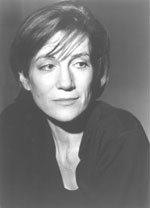
Harriet Walter herself was just sublime, like a Kristin Scott Thomas who can laugh at herself, and very beautiful, these 20 years after her turn as Lord Peter Wimsey’s amour Harriet Vane. And afterward I screwed up my courage and asked her for her autograph, in my old copy of my favorite of all the Wimsey-Vane novels, “Busman’s Honeymoon,” since Sayers herself described it as “a love story with detective interruptions.” She was gracious and said, about the novel, “Oh, it’s the one that got away,” since for some untold reason the Sayers estate sold the film rights to someone who won’t let anyone make a film of it.
Oh, and on the way to the event, would you believe: I was on one of the many streets I wasn’t meant to be on, getting loster and loster, when I looked up to see… Avery’s PS 234 friend Phoebe, and her family, wandering hand in hand along the pavement! Her mother Liz had emailed me to see if we were around this week and would we like to get together, and then smack! there they were right in front of me. Perhaps dinner tomorrow night.
Well, Avery has just made her first cake, from her first real-live cookbook recipe, and is now reposing in her bath and I’ve promised to read aloud. I’ll let you know how the cake turns out, and it could be Avery’s first recipe on my blog, properly cited in its original context, of course. I must say, I get very sentimental when she likes something I like, or liked as a child, and to pass along all my Ginnie and Geneva books and have her enjoy them is very satisfying indeed. And with the wonders of internet searches, you can get copies for your daughters, too.